
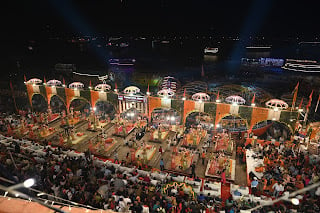
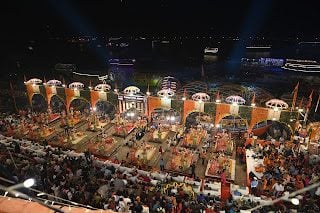
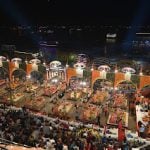
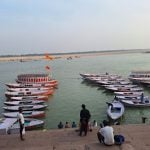
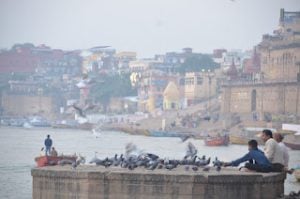
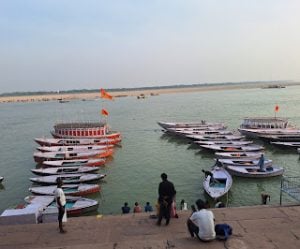
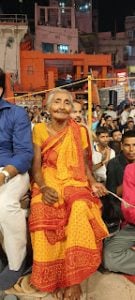
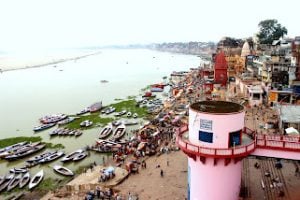
My visit to Dashshwamedh Ghat the other day, perhaps my first this year, coincided with the evening Ganga arti. The arduous task of wading through the sea of humanity that attends the Ganga arti, almost daily, was enough reason not to be part of an activity that had been an essential element of my nightlife ever since I moved to Banaras more than a decade ago.
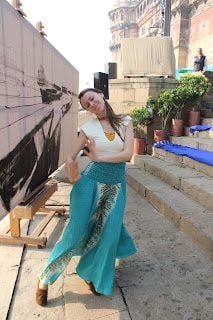
What was quite noticeable was the presence of some groups of foreign travellers, which was a common sight before the pandemic hit us.
The Aarti Becomes a Domestic Draw
Post pandemic, this evening ritual has become a domestic traveller’s activity primarily, since the number of such travellers coming to Banaras has increased manifold due to various reasons, the prominent being the setting up of the Kashi Vishwanath corridor, while the footfall of foreign travellers has considerably declined, again due to various factors.
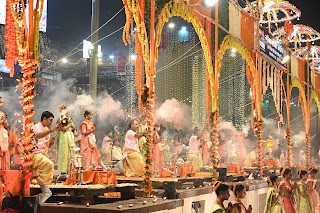
What really crossed my mind suddenly, while watching these foreigners negotiating for space at the jam-packed ghat, was how they are coming to terms with the changed Banaras. The city is deluged with domestic travellers from all regions of the country who have erased the concept of seasonal tourism, which the city had known till a few years back, when the tourists ( read foreign travellers) frequented the city between the months of October to March.
The predominance of these domestic travellers is not only seen in the major tourist spots of the city, like the ghat, which I mentioned earlier, but also in the logistics involved in the tourism industry, like the hotels, transportation, etc.
While interacting with the guides or agencies who are handling the tour of these inbound travellers, they do agree that it is a cultural shock for some of them to witness such heavy crowds. The number of people attending the Ganga arti has increased four to five times, so this involves a lot of preparation, while handling a group of foreign travellers.
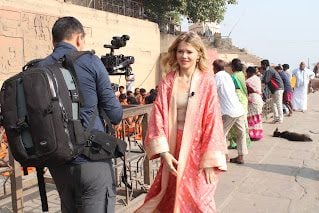
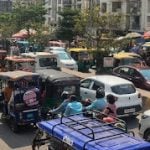
One of the guides shared that now it is tough to organise a rickshaw tour, which was a major way for us to bring these foreign travellers for the evening Ganga arti at the ghat. Earlier, the group would reach a point sitting on a rickshaw, going through some parts of the city and would walk to the ghats that gave them an actual feel of the city.. This has become unfeasible due to traffic restrictions coming in place because of constant VIP movements and the constant flow of domestic tourists. Even the walk on the road towards the Dashshwamedh ghat is no longer enjoyable to them, as fighting for space on the road is a major task.”
This intensity is difficult to deal with for inbound travellers, so a majority of them only stay for a night. “Only a few stay for a longer period. Earlier, the minimum stay for foreign travellers was at least two to three nights. A lot of their favourite activities, like walking on the ghats, exploring the lanes, have been curtailed due to overpopulated ghats and lanes,” says Kuldeep Kumar, who is in the hospitality industry.
When Development Dilutes the Charm
The kind of development happening is diluting the old-world charm of the place, which was the major attraction for them, feel a lot of travel agents.
This change has reduced the number of inbound travellers to the city. Shipra Bhargava, a senior official at a luxurious hotel chain, says, “The footfall of foreign travellers has gone down by nearly fifty per cent. As the major revenue is coming from domestic travellers, the hospitality industry is concentrating more on them, despite them being more demanding. We are bringing a lot of change to accommodate our new clientele. Our food has become spicier according to the Indian tastes, which was earlier blander, keeping our foreign guests in mind. The hospitality industry is now shifting according to the needs of the domestic tourists.”

Hmmmm!
Wonderful observations.